Right of Way Rules in Norway


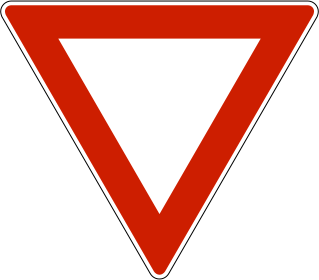

Right of way is where many foreign drivers run into trouble in Norway. The rules are logical once you understand them, but they differ significantly from UK and US conventions. The most important concept: the right-hand rule — and it applies far more often than you’d expect.
The right-hand rule (høyreregelen)
At any intersection without traffic signs, lights, or markings indicating priority, the vehicle approaching from the right has priority. This is the default rule in Norway and applies in situations where UK and US drivers wouldn’t expect it:
- Residential areas with no signs
- Small crossroads in villages
- Minor roads that appear equal in size
- Parking areas
If you’re approaching an intersection with no signs, look right. If a car is coming, you must yield.
How to recognise priority
Norway uses clear visual cues:
- Yellow diamond sign — you have priority on this road
- Inverted triangle (yield sign) — you must give way
- Stop sign — complete stop required, then yield
- No signs — the right-hand rule applies
The yellow diamond is common on main roads. When you see it, side traffic must yield to you. When priority ends, you’ll see the same sign with a line through it.
Roundabouts
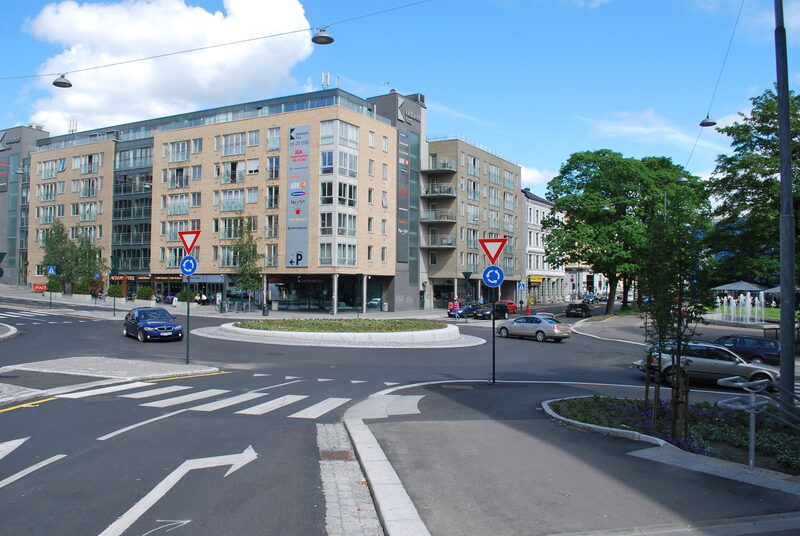
The rule is straightforward: give way to traffic already in the roundabout. Yield to vehicles coming from your left as you enter. Traffic flows counter-clockwise.
Use your indicators: signal right when exiting the roundabout. In multi-lane roundabouts, position yourself correctly before entering — inside lane for exits past halfway, outside lane for early exits.
Trams
Trams have special priority in Norwegian cities (mainly Oslo and Bergen): always give way to trams. They cannot swerve or stop quickly.
When a tram stops to let passengers on or off, you must stop and wait if there’s no safety island — passengers may step directly onto the road.
Pedestrians
Pedestrians at marked crossings have right of way. You must stop for them. Norwegian pedestrians generally expect cars to stop, so anticipate them stepping onto the crossing.
Practical tips
- When in doubt, yield. Better to stop unnecessarily than cause an accident.
- The right-hand rule catches tourists in quiet residential areas where cross-traffic unexpectedly has priority.
- Watch for the yellow diamond — it’s your clearest indicator of who has priority.
- Eye contact helps. At ambiguous intersections, making eye contact with other drivers helps establish who goes first.
How Norway compares
🇬🇧 United Kingdom vs. Norway
No general 'priority to the right' rule. Priority determined by road markings, signs, and conventions.
Priority to the right at uncontrolled intersections. Roundabouts: yield to traffic already circulating.
🇺🇸 United States vs. Norway
Four-way stops common. First to stop has priority. No general right-hand rule.
Priority to the right at uncontrolled intersections. No four-way stop concept.