Lights & Visibility Rules in Norway
Norway requires headlights to be on at all times — day and night, summer and winter, rain or shine. This isn’t optional, and it’s one of the rules that surprises drivers from countries where headlights are only required after dark.
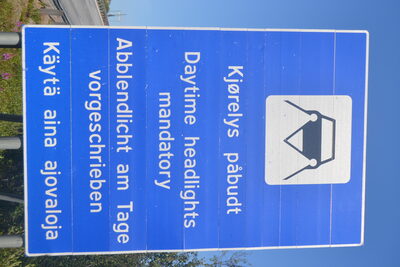
Headlights on at all times
Norwegian law requires that your vehicle’s dipped headlights or daytime running lights (DRL) are on whenever the engine is running, regardless of conditions. This applies 24 hours a day, 365 days a year.
Most modern cars sold in Europe have automatic DRL, so this happens without you thinking about it. However, if you’re driving an older car or one from a market where DRL isn’t standard, you must manually switch on your dipped beams.
Tip: DRL typically only lights the front of the car. In dark or foggy conditions, you need full dipped beams to also illuminate your rear lights.
Fog lights
- Front fog lights may be used in addition to dipped beams in fog, heavy rain, or snowfall
- Rear fog lights should only be used when visibility is significantly reduced (below roughly 150 metres). Using rear fog lights in clear conditions is illegal because they dazzle following drivers.
Reflective vest
While not required to be worn while driving, it’s highly recommended (and in many European countries required) to carry a reflective vest in the car. If you need to stop on the roadside — especially in winter darkness — a reflective vest is essential for your safety.
Some tunnel regulations and emergency procedures may require you to put on a vest before exiting your vehicle.
Visibility in Norwegian conditions
Norway’s lighting conditions are extreme by European standards:
- Winter darkness: In northern Norway, the polar night (mørketid) means no daylight for weeks. Even in southern Norway, winter days are very short.
- Summer midnight sun: In the north, the sun doesn’t set in summer. Despite the brightness, headlights are still required.
- Tunnel driving: Norway has over 1,100 road tunnels, some extremely long (the Lærdal Tunnel is 24.5 km). Good headlights are crucial, and many tunnels have specific lighting zones.
Practical tips
- Check your lights regularly. A burned-out headlight or taillight will get you fined.
- Adjust your headlights if you’re driving a UK car (right-hand drive) in Norway — your beam pattern may dazzle oncoming traffic. Headlight adaptors are cheap and available at ferry terminals and automotive shops.
- Don’t use high beams when there’s oncoming traffic or when following another vehicle. Norwegian roads are often narrow, and high beams are particularly blinding on snow-covered roads.
- In tunnels, keep your headlights on (dipped beam, not DRL) so that both front and rear lights are visible.
How Norway compares
🇬🇧 United Kingdom vs. Norway
Headlights required between sunset and sunrise, and in poor visibility. Daytime running lights (DRL) not mandatory.
Headlights (dipped beam or DRL) must be on at all times — day and night, all year.
🇺🇸 United States vs. Norway
Headlight laws vary by state. Generally required from sunset to sunrise and in poor visibility.
Headlights always on — 24 hours a day, 365 days a year.